
Imagine you're in your mid-20s and have only been in your role for a few months, and then you're suddenly told you need to make 13 people redundant in a single day. Some of them have worked there longer than you've been alive.
Would you rather:
🅰️ Be given a tight script and a step-by-step process to follow
🅱️ Be given a loose set of guiding principles and told, “we trust you to figure it out”
Now imagine you're working in a smaller organisation that prides itself on its high-autonomy culture. You've recently been promoted and are now managing a handful of people who used to be your peers. It turns out one of them, and your closest friend, is underperforming, and you know they've got a lot going on at home.
Would you rather:
1️⃣ Be given a tight script and a step-by-step process to follow
2️⃣ Be given a loose set of guiding principles and told, “we trust you to figure it out”
I bet you’re thinking, “Is there a third option?”
High-autonomy cultures often need just as much structure
The underlying assumption in high-autonomy cultures is that if we trust people to do their jobs well, that trust carries over into performance conversations. But often managers are SO focused on their DAY jobs that they don’t always make the same kind of time or apply the same level of attention to the job of being a LEADER.
Coaching, giving feedback, and having a hard conversation with someone you care about - these are all leadership skills. But being excellent at engineering, design, or sales doesn't necessarily mean you are naturally a good leader (I’m sure I’m preaching to the choir here).
Yet, most of the time in HR, we either default to either:
- providing a rigid process for managers to follow to remain compliant, and accidentally strip some of the humanness away in the process, or
- deciding that the in-depth guidance isn’t necessary because our managers already have high levels of capability and autonomy, in which case, we can inadvertently leave managers in the lurch.
A blank canvas doesn't feel like freedom if you've never been taught how to use one. It feels like exposure.
Similarly, a rigid instruction manual doesn’t feel like support if you’ve done the job a million times. It feels like micro-management...
PREVIOUS NEWSLETTERS
In case you're a new reader (or just missed them), here are the past few newsletters:
- Accountability isn't an HR problem - where we challenge the assumption that measuring platform usage or adoption equals accountability for performance
- The choice to co-create that changed everything - where we showcase Pixelogic's iterative approach to building company-wide ownership for performance
- Getting 75+% of your people satisfied with their career progression - where we provide four steps to designing an employee experience that increases engagement
Finding the Goldilocks of manager support
The answer isn't templates or no templates. It's matching the scaffolding to the manager and the conversation.
Think about how kids learn to swim. They aren't thrown into the water and told to figure it out. Instead, they’re shown how to turn their head and breathe, then how to kick their legs, then how to use their arms. It's one thing at a time, layered up, until you can put it all together.
The scaffolding builds the muscle. It doesn't replace it.
Here are three considerations for how to design the right amount of structure into your guidance for managers:
🔀 Match the level of scaffolding to the type of conversation. Some conversations require more guidance (e.g., redundancies, performance plans, role changes). Some require less (e.g. regular catch-ups with experienced direct reports). Knowing the difference is part of the design work. A workflow that adapts to the type of conversation, rather than treating every interaction the same way, is where this becomes practical.
💡Design prompts that teach a leadership habit, not just produce an output. A template can be a form to complete or a coach in the room. The first creates compliance. The second builds capability. There's a difference between "follow this script" and "here are three things to reflect on before you have this conversation."
👀 Build visibility into your solution so you can see who's outgrown the scaffolding. Some managers will need hand-holding longer than others. Your system should let you see which is which, so you're not over-engineering for those who don't need support or abandoning those who do.
IN PARTNERSHIP WITH PX DOJO
Reading about PX is one thing.
Knowing where to start is another.
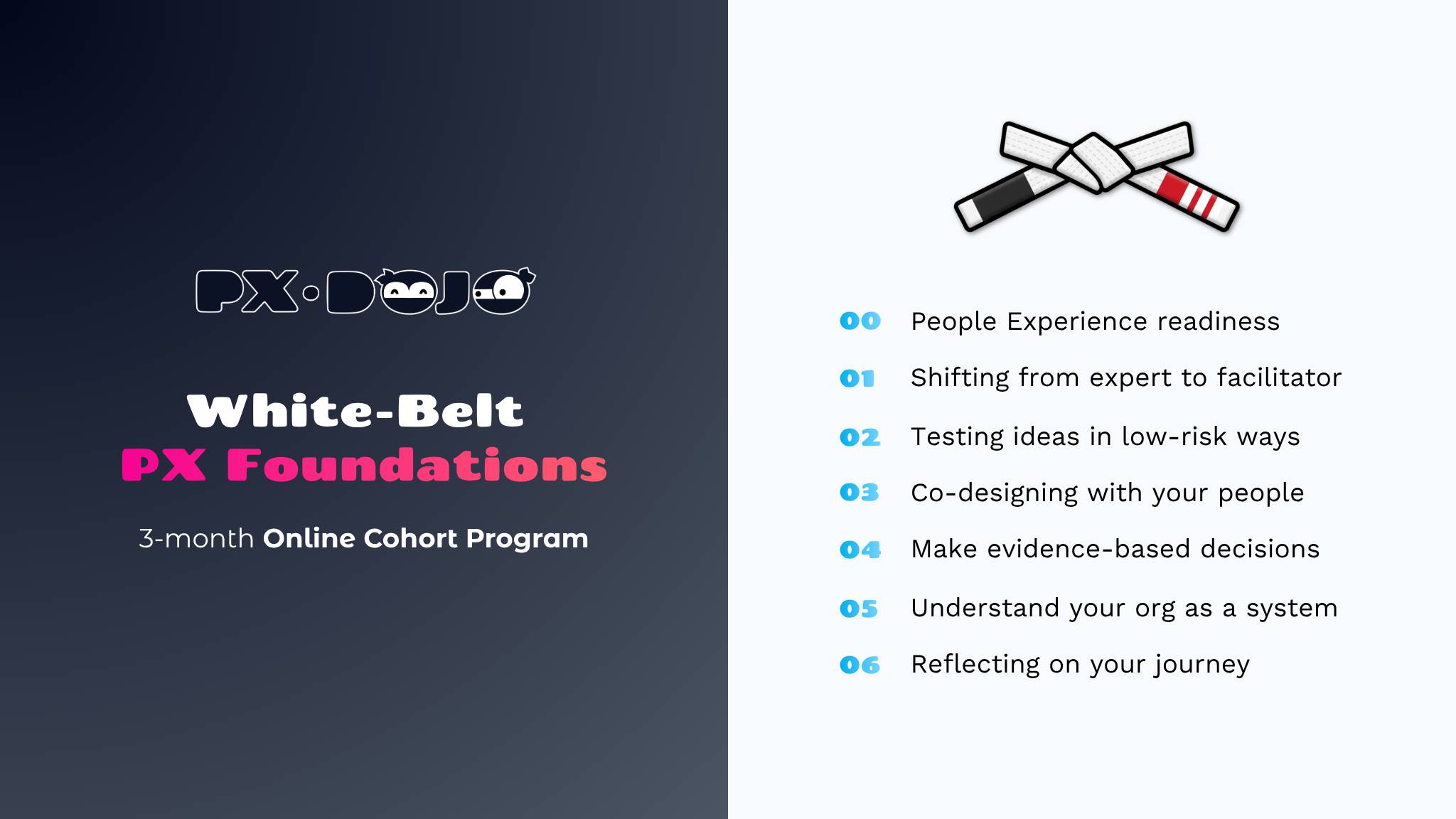
If the ideas in this newsletter are landing, but Monday morning rolls around, and you're still not sure how to actually apply them in your own organisation, you might like to check out what our friends are doing over at PX Dojo.
PX Dojo's 3-month White-Belt PX Foundations Course gives you the methods, language, and a cohort of peers to practise the fundamental mindsets of People Experience. The program involves 6 live 90-minute workshops, run fortnightly, to provide you with a safe space to experiment with the methodologies we discuss in this newsletter.
What signal are you sending?
I was recently reading What Pay Costs by James Seechurn, where there was a line about how "too much rigid structure restricts freedom of thought, signals to stay in the lane, stops people innovating on their own careers."
He's right. But the flip side is just as true. Too little structure does the same thing. It stops people innovating because they're frozen, not because they're free.
Where are your managers stuck right now? Do they have too much structure, or not enough?
Want to talk through what this looks like for your organisation?
Book a demo