
Accountability for people development is a leadership choice
In my various People Experience roles, I have come up against the same pattern time and time again…
HR Leaders measure adoption of their performance platform as the metric of success of their performance approach. In particular, as a metric of manager accountability.
It starts with good intent; asking managers to have quarterly performance or progression conversations or introducing a goal setting framework to create some structure.
But instead of measuring the impact of those activities, we measure the number of people who said they had a performance conversation or the % of utilisation of a feature in a platform.
Unwittingly, though, measuring adoption optimises for optics, not performance. In the UX world, we’d call these vanity metrics because they measure ‘access’, not ‘activation’.
The two costs of equating accountability to adoption
In my experience, when we focus on pushing the adoption of tools or processes, we either drive people to ‘perform performance’ or disengage with it entirely.
When leaders or teams disengage from performance processes, HR ends up chasing people up because their own success is measured by adoption. Leadership is frustrated because performance isn’t improving, and HR are frustrated that all their hard work isn’t resulting in behaviour change. Suddenly, HR are being held accountable for performance instead of managers.
Worse than that is when adoption is high, but performance hasn’t improved. I’ve had teams tell me they've ticked the box to say they'd had a conversation with their manager about performance because they felt they had no other choice. In this type of scenario, team members begin to see reviews, one-on-ones, and feedback as something for HR’s benefit rather than their own.
Adoption does not cause behaviour change. But we use it as a performance metric because we often haven’t aligned on what true leadership performance looks like or how we should hold leaders to account.
True accountability isn’t about adoption...
Previous Newsletters
In case you're a new reader (or just missed them), here are the past few newsletters:
- The choice to co-create that changed everything - where we showcase Pixelogic's iterative approach to building company-wide ownership for performance
- Getting 75+% of your people satisfied with their career progression - where we provide four steps to designing an employee experience that increases engagement
- What people remember tells you more than any survey - where we share how 15-minute conversations can provide quality data to inform your people roadmap
What accountability looks like at the extreme
I’m an avid Hamish & Andy listener (stick with me for a moment). In their podcast, they’ve often talked about how they’re unsure how Australia’s health star ratings are determined because they don’t always seem to add up.
Unhealthy food products that have a 5-star rating versus seemingly harmless products having a 0.5-star rating.
So, Hamish goaded Andy into applying for a health star rating for his dim sum product and into gaming the system a little. Then their lawyer got wind of the idea.
Their lawyer dissuaded them from this little prank by pointing out that the fine for misrepresentation starts in the tens of millions and goes up from there.
They were completely gob-smacked. But the point is that the consequences for misrepresentation are so outrageous that people won’t test the boundaries. If the fine were only $5000, more companies would game the system.
Most approaches to accountability for performance take the opposite approach. They build the appearance of accountability with none of the substance. A tick box that nobody enforces. A metric that nobody seems to look at. And once people work out that there's no real cost to managers for not truly creating the conditions for people to thrive, the system teaches them that the rules are theatre.
Accountability needs to be designed, not only enforced
When HR designs performance processes and imposes them on leadership, we’re doing to them exactly what we advise them not to do with their teams: micromanaging. No wonder they don't adopt it. They don't believe in it because they were never involved in designing the approach.
The alternative is to take off the ‘HR Expert’ hat and put on that of the ‘Facilitator’. Get leaders in a room to agree on what performance looks like in your organisation and what levers will drive those behaviours.
Once you’ve agreed on those levers, the next step is to align as a leadership team on what those levers should look like in practice, and what level of accountability you’re going to back them with.
The accountability spectrum
To truly drive accountability for performance amongst your leadership population, you need to decide where you sit on the accountability spectrum. I was chatting with Mark Lewis about this the other day, and he shared an overview of the levels of accountability he’s witnessed:
- 🫱🏽🫲🏾 Trust-based: we trust you, you're an adult
- 💬 Quiet check-in: the manager's manager asks about it in a review conversation
- 📈 Reported metric: HR tracks it, the manager and their manager can see the numbers
- 👀 Transparent metric: visible across the management cohort, so there's peer accountability built in
- 🧭 Consequential: it impacts reviews, remuneration, and progression
- ⚠️ Final: persistent non-performance is a reason to part ways.
Every organisation sits somewhere on this. Most haven't decided where.
What to do next time adoption is low
If adoption is low, I'd gently suggest you stop chasing managers. Instead, have a conversation with your leadership team (if not at all levels of the organisation) covering the following questions:
- Have we agreed that this matters and is the right lever to build a high-performing culture?
- Where do we want to sit on the accountability spectrum, especially when a manager isn’t showing up for their team?
- How do we expect this to improve our organisation’s performance?
- Instead of only measuring adoption, how can we measure whether it has improved our team’s ability to do great work?
Adoption measures compliance. What you really want to measure is impact.
One of the reasons I genuinely love writing this newsletter for Crewmojo is that the platform is built on the philosophy that HR workflows should be designed around an organisation’s unique context. Rather than imposing a process, you can work with your leadership team and employees to determine the right approach to performance for your organisation. Then design the process, the accountability layer, and the metrics around it.
IN PARTNERSHIP WITH PX DOJO
Reading about PX is one thing. Knowing where to start is another.
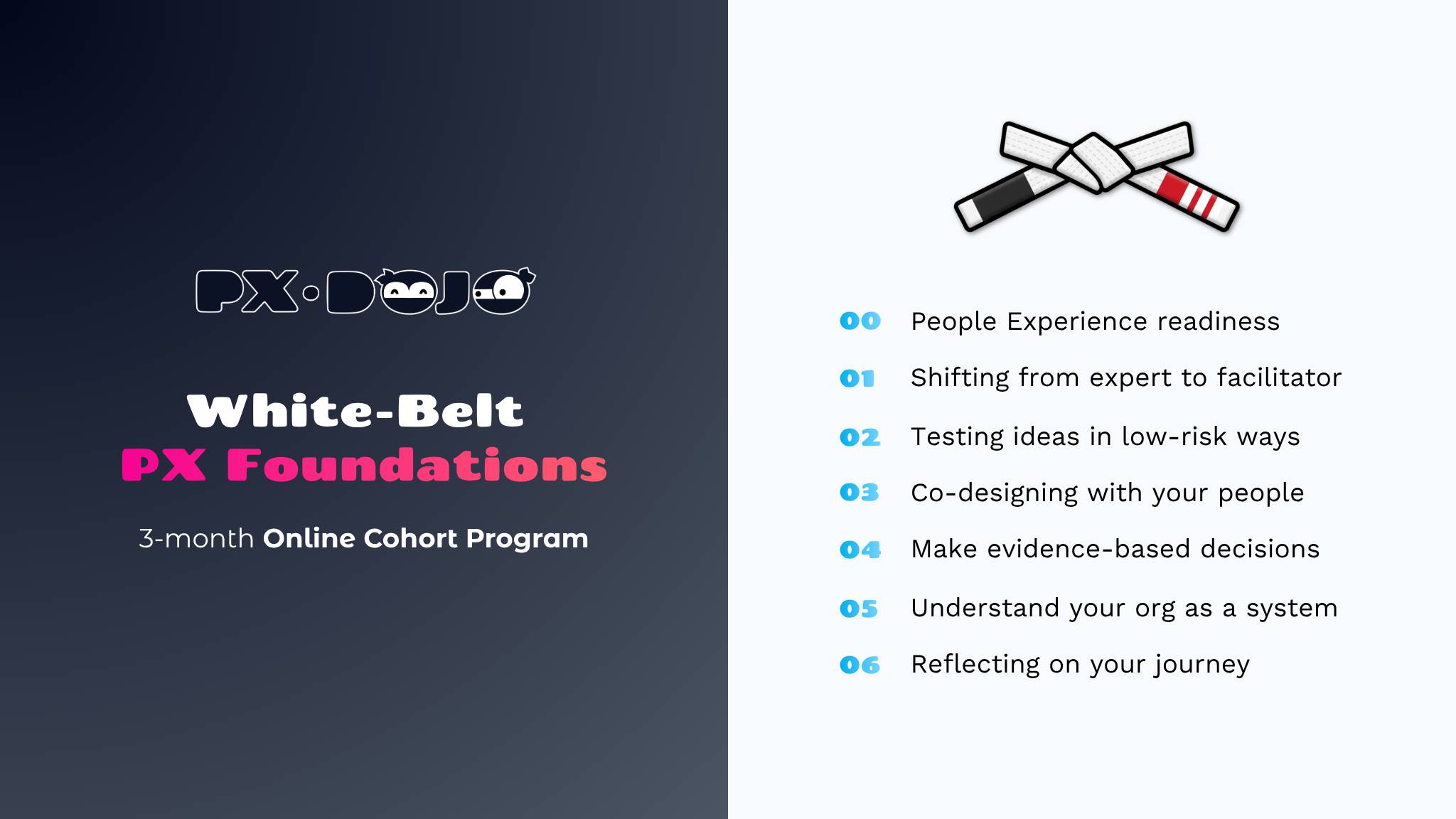
If the ideas in this newsletter are landing, but Monday morning rolls around, and you're still not sure how to actually apply them in your own organisation, you might like to check out what our friends are doing over at PX Dojo.
PX Dojo's 3-month White-Belt PX Foundations Course gives you the methods, language, and a cohort of peers to practise the fundamental mindsets of People Experience. The program involves 6 live 90-minute workshops, run fortnightly, to provide you with a safe space to experiment with the methodologies we discuss in this newsletter.
Early bird tickets are now on sale until 28th May.
What to take away
HR can support leadership choices about accountability, hold up a mirror to people development, and co-design the levers that drive performance. But HR cannot decide whether it all matters. And if leadership hasn’t decided on how to hold leaders accountable, managers already know, because the absence of consequence is its own message.
If you're seeing low adoption and reaching for a better tool, a better template, or a better rollout plan, the first thing to check is whether the mechanism and accountability for using it have been co-designed.
'd love to hear from you. WWhat kind of adoption are you trying to drive at the moment, and what level of accountability (based on the spectrum above) have you put in place?
Want to talk through what this looks like for your organisation?
Book a demo