
The choice to co-create that changed everything
How Pixelogic are building company-wide ownership for performance
When Pixelogic Media's top leaders decided the organisation needed an updated set of values, they did what many leadership teams do: they got in a room and brainstormed.
But what I loved about this story is that instead of sitting in their ivory tower and whittling their initial 50 ideas down behind closed doors, the execs took a co-creative approach. They asked leadership to narrow the list to roughly 20, and then sent the shortlist to every employee across the globe and asked: which of these feel core to working here?
Russ said the best thing about this approach was the buy-in that came from people seeing their own fingerprints in the final eight values and a rewritten purpose statement.
So how does a team keep making decisions like that? Not just for the values work, but across everything they do.
Well, they don't just take a shot in the dark or work off gut-feel and hope for the best. Russ's team continuously draws on two types of data from across the business to prioritise their work and sense-check whether it's having the intended impact:
- qualitative: ongoing conversations with stakeholders and leaders, regular check-ins, and ad hoc drop-ins with teams across the business
- quantitative: pulse surveys and structured feedback through Crewmojo, grounded in what people are actually doing in their roles (not just aspirational career questions)
It's that combination that helps them spot what to focus on and when something isn't landing. And it's how they knew their approach to embedding the values wasn't working as intended...
Hey everyone,
We’re doing something a little different in this newsletter. This is a summary of an inspiring conversation Megan Bernard-May had with Russ Heptinstall from Pixelogic Media about their approach to People Experience
Pixelogic is a global media services company based in Burbank, California, that provides end-to-end solutions for content localisation (dubbing & subtitling), audio services, distribution, theatrical services and mastering. Russ leads learning and development, but his remit stretches well into talent management, performance, and beyond.
What made this conversation worth sharing isn't a big transformation story with a neat ending. It's a story about iteration. About trying things, watching them not quite land, and going again.
🎧 If you’ve got time, the conversation between is worth a listen:
What happened when they tried to connect values to performance
With the values in place, Russ's team tried what felt like the logical next step: weaving them directly into their yearly performance check-ins. The hope was that they'd give structure to the conversation between managers and employees.
It didn't land.
They didn't. The values were too broad. The questions were too open. Managers (especially new ones) got lost. There just wasn't enough structure to help people talk about what performance actually looked like in their specific role.
A lot of teams would have either pushed through or scrapped the whole project. Russ's team did neither. They asked: What if we took a different approach?
The co-creation and iteration
Russ's team realised they needed to make the connection between "what we stand for" and "what that looks like in your role" much more concrete. So they introduced capabilities (or competencies) underneath each value, four or five per value.
And they are using the same co-creative approach that had worked for the values themselves:
- working with leadership to identify the capabilities most relevant to each department,
- getting employees' perspectives with more targeted questions: of the capabilities your leadership selected, which are most important to you? And which of those connect to the KPIs and measures in your day-to-day role?
- sifting through the data to design something that will be simple for managers and employees to use and understand,
- using CrewMojo's sandbox environment to build and test before rolling out, and leveraging staggered review cycles across regions to pilot with one group before refining for the next.
If, throughout the process, a capability didn't fit cleanly under one of the eight values, they let it go. They wanted a clear line from the purpose statement to what each role actually does and how it should show up in the day-to-day experience of work.
The power of closing the loop
What runs through all of this is a commitment to co-creation that goes beyond just asking for input. Russ's team follows up and continues to iterate.
Within a month of gathering employee input, they presented the findings at a company-wide town hall, along with an outline of how they were using them.
That transparency changed the dynamic between the business and their team. People could see that their input shaped the direction of the organisation. They weren't being asked for feedback just to feel included. They were being asked because their input was actually being used.
People started bringing ideas and feedback to the team unprompted. Russ shared an example of how an unplanned conversation with a team during an office visit led to one of their most successful developments.
By acting on what would actually make a difference to people, they built the trust that makes the next round of co-creation easier. People come forward. They offer ideas. They ask "how can I help?" rather than "why should I bother?"
Not everyone was on board immediately. Some were hesitant, some opted out entirely. But by being transparent about how the data would be used, and showing people the results and decisions that followed, the team slowly changed hearts and minds.
Values that land AND build performance
I love this story because it demonstrates how what some perceive as a “fluffy” or “performative” exercise can connect and align an organisation if designed through a co-creative approach.
The values they developed became more relevant because they were built intentionally to:
- strongly connect to the work people do
- enable conversations with clients about the standards they hold
- and empower managers to have higher-quality conversations about performance,
And in the process, they build trust amongst their people that they have a say in how the company is run.
IN PARTNERSHIP WITH PX DOJO
Reading about PX is one thing.
Knowing where to start is another.
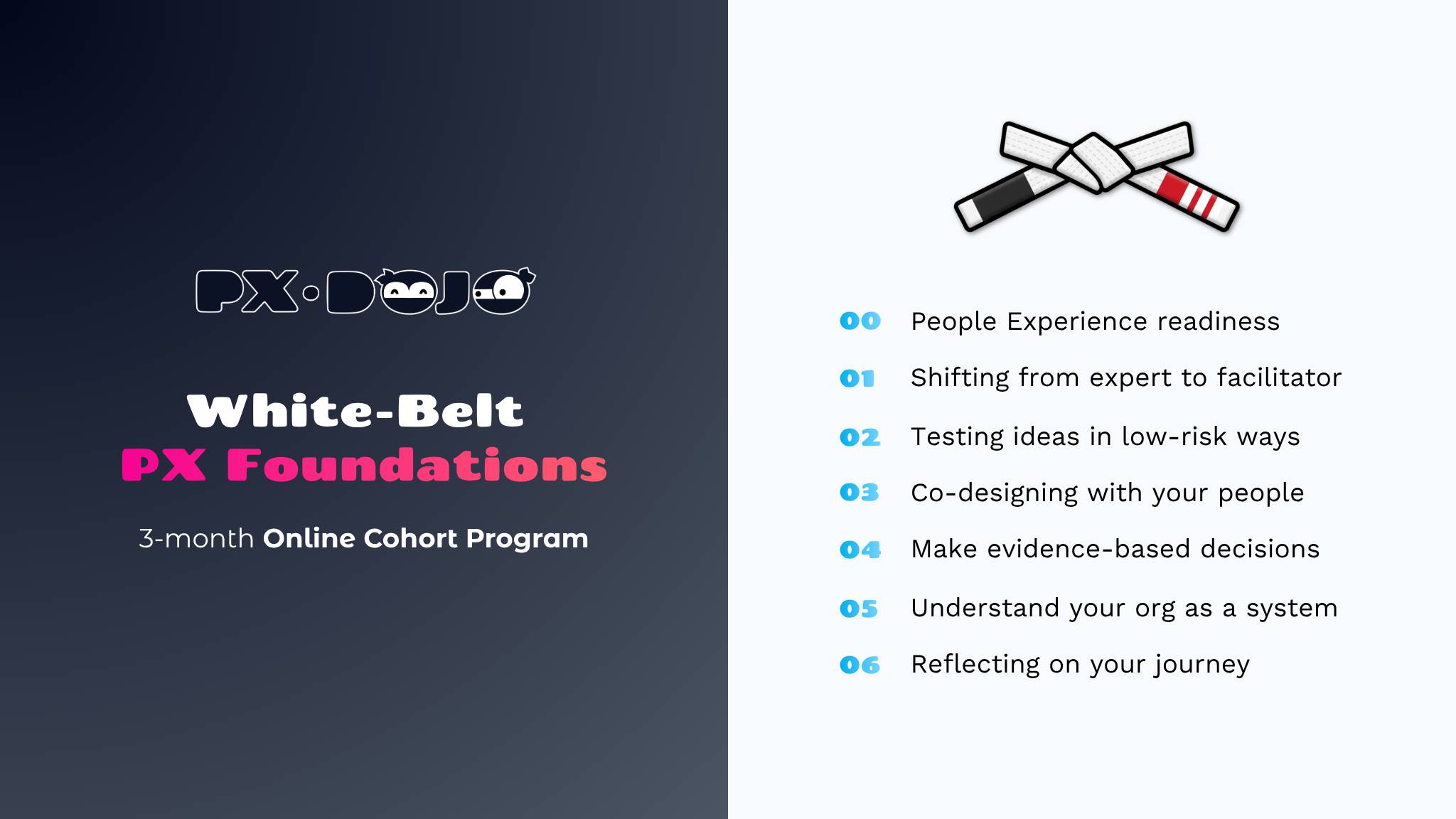
If the ideas in this newsletter are landing, but Monday morning rolls around, and you're still not sure how to actually apply them in your own organisation, you might like to check out what our friends are doing over at PX Dojo.
PX Dojo's 3-month White-Belt PX Foundations Course gives you the methods, language, and a cohort of peers to practise the fundamental mindsets of People Experience. The program involves 6 live 90-minute workshops, run fortnightly, to provide you with a safe space to experiment with the methodologies we discuss in this newsletter.
As a reader of Crewmojo's Newsletter, you're getting special access to Super Early-Bird pricing (20% discount). Early Bird Sales launch publicly on the 18th May.
What to take away from this story
Throughout the conversation, four principles kept surfacing in the way Russ and his team approach this work. If you're exploring what a more iterative approach to performance could look like, these are worth embedding in your work:
🗺️ Align to the cadence of the business, not your own roadmap. If your people team's timeline is working against the natural rhythm of the organisation (busy periods, fiscal cycles, project deadlines), you're pushing against the tide. Russ's team learned the hard way that implementation timing matters as much as what you're implementing.
💻 Make sure your tools fit in the flow of work. Performance processes should feel like part of someone's day-to-day, not another task bolted on. When the technology meets people where they already are, adoption follows naturally.
💬 Stay close to the people doing the work. The thing that got the most positive response from Russ's entire organisation came from a drop-in conversation, not a strategic plan. People teams often sit in the back corner of the office (for good reason, sometimes), but proximity to the rest of the organisation is one of the biggest advantages we have. You don't always need a formal discovery process. Sometimes you just need to be there.
⬆️ Keep the capacity to respond to what you hear. If your roadmap is so full that you can't act on what you learn from being close to the work, the proximity doesn't help. Russ's team was able to reprioritise and build something that mattered because they hadn't committed every hour to planned work.
And sitting underneath all four of those: absorb the complexity so your people don't have to. Russ put it simply: the less work his team does in the background to prepare these experiences, the less value the end result provides. The co-creative process, the iterative testing, the piloting and adjusting, that's how they take on the complexity so it lands simply for the people using it.
The work is never done. And it's not supposed to be.
Want to talk through what this looks like for your organisation?
Book a demo