
Start the year off on the right foot...
Happy New Year!
As the year gets going again, there’s often a quiet pressure to get ahead of things early. Before priorities stack up, before delivery slips, before you start feeling like you’re already on the back foot.
It’s also usually the point where leaders start looking for ways to get clearer on what’s really helping or hindering performance. They too, are hoping to start the year on the right foot.
One tool I’ve found particularly useful is Culture Mapping (originally designed by Dave Grey), which I first came across during my UX days. I’ve returned to it many times since because it helps surface where day-to-day behaviours, leadership approaches, and business strategy are misaligned, often in ways that aren’t immediately obvious.
I first used Culture Mapping when several Engineering Managers came to me with concerns about inconsistent engagement and performance across their teams. I was experiencing it too. As the sole UXer working across six software engineering teams, I was constantly moving between groups with very different energy, expectations, and ways of working.
We needed a shared way to understand how our existing cultural norms were impacting performance, and how to change them. That’s when I suggested Culture Mapping.
Culture Mapping is a practical, no-frills tool leaders can use to run a cultural audit. When it’s paired with a clear Performance Philosophy (which we’ve talked about in a previous newsletter), it makes the gap between how work actually gets done today and the culture you’re aiming to build more visible.
I keep coming back to this tool because it gives leaders clarity on three things that are often hard to understand simultaneously:
- ⚽️ the current state of the culture
- 🥅 how that culture is affecting day-to-day performance
- 👟 the underlying drivers shaping the norms that need to change
Before delivery pressures start to dominate the conversation, why not give Culture Mapping a go? It will provide you with a way to pinpoint which parts of your People Experience needs to change (or be maintained) to support stronger performance.
Culture Mapping clarifies performance levers
The biggest value that comes from running Culture Mapping is a true understanding of which factors are shaping performance.
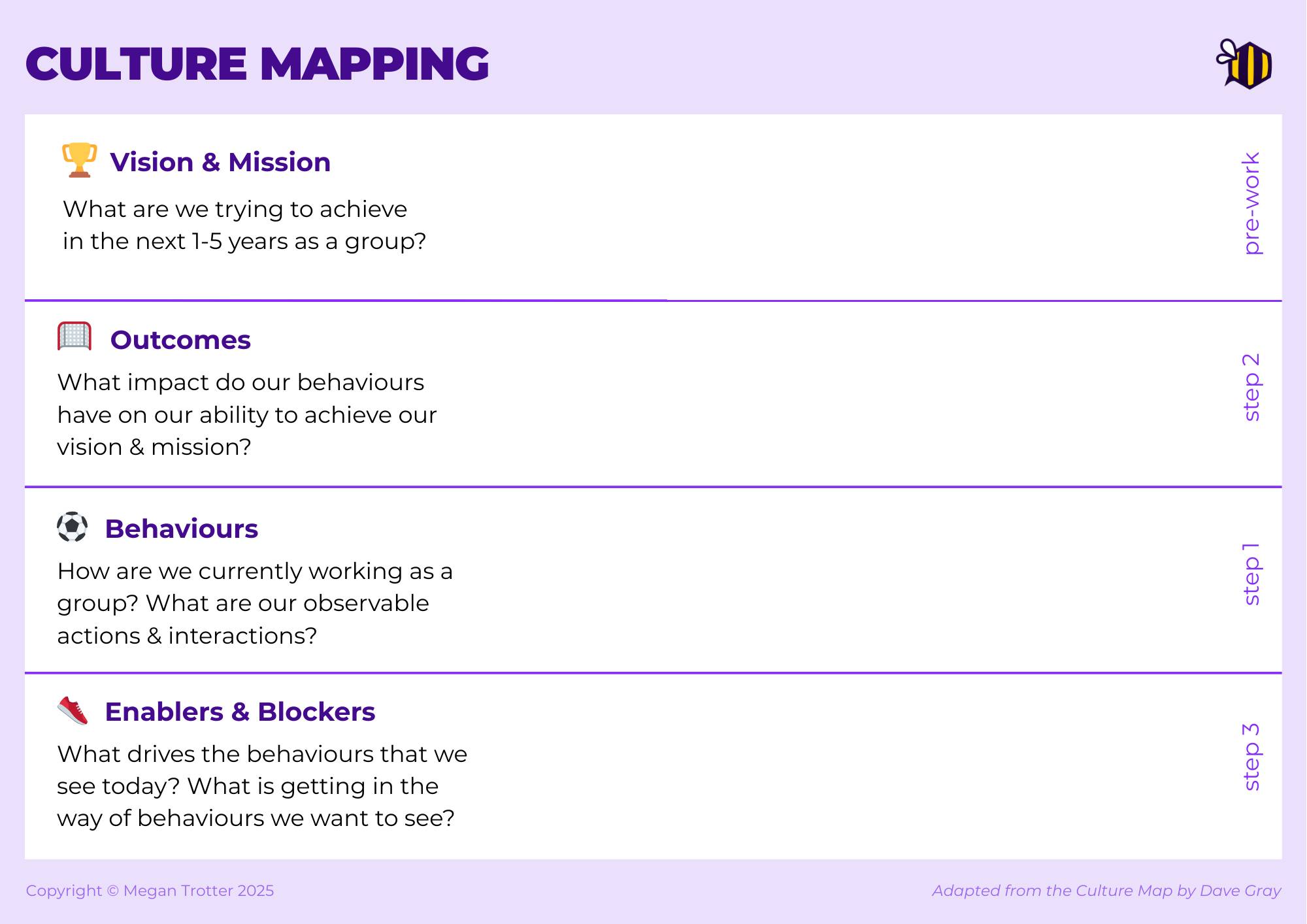
It dismantles the idea that 'culture' is too soft to measure by breaking it down into three practical components and relating it back to the vision & mission of the organisation:
- Behaviours: Observable, day-to-day interactions and ways of working. This shifts conversations away from vague concerns about “culture” and toward how teams are actually functioning (intentionally or otherwise).
- Outcomes: The tangible consequences of those behaviours, whether that shows up in delivery speed, quality of work, customer experience, or results and it's impact on the overall vision & mission.
- Enablers and Blockers:The underlying drivers of behaviour. These include leadership approaches, assumptions, or rules, as well as HR processes and policies that reinforce or discourage certain ways of working. This is where most performance issues are rooted.
Here’s an example of a common tension Culture Mapping surfaces:
An organisation might say it wants leaders to act as enablers and for teams to work with a high degree of autonomy to achieve the mission & vision of the company. But when using Culture Mapping to identify the day-to-day behaviours, you might see something different: Team members wait for instructions instead of making decisions themselves.
The result (or the outcome) is slower work and increased dependence on the leader. This often comes from a habit of leaders giving tasks instead of agreeing on what good looks like and letting the team decide how to get there. Many leaders do this because they believe it’s quicker to just tell people what to do. Over time, this sends a message that independent thinking isn’t really expected. The blocker in this case to autonomous decision making is a leadership behaviour.
By mapping the current culture and comparing it to what the company says it values (ideally outlined in the Performance Philosophy), these contradictions become visible. More importantly, the specific enablers and blockers that need to change are surfaced.
Culture Mapping isn’t just for spotting "problems" though. It’s equally powerful for highlighting behaviours that are working well and identifying exactly what is enabling them so that those drivers can be reinforced.
For example, when I ran a Culture Mapping session with a leadership team at the BBC, they recognised that much of their success came from team members building strong relationships with internal and external partners. When we explored what encouraged this behaviour, it came back to leadership noticing and celebrating it. Case studies that highlighted how collaboration led to success were shared across the department, reinforcing the behaviour and helping more reserved team members see how building relationships could support their own success.
Articulating behaviours, outcomes, and drivers delivers two immediate benefits:
- ✨ Clear PX priorities: Instead of guessing where to intervene, you can focus on the few People Experience changes that will have the greatest impact on performance.
- 💪 Leadership ownership: Because leadership are involved in surfacing the behaviours of the team, the impact on the team's success and the leader's role in driving those ways of working, accountability stays with leaders rather than being passed entirely to HR.
A toolkit for Culture Mapping:
Running Culture Mapping is more time-efficient than an annual engagement survey and gives you insight you can act on immediately.
To create an initial map, you need around 30 minutes of preparation and a 90-minute working session with your leadership team. The focus is on meaningful discussion, building shared understanding and impetus to take accountability for team culture, rather than documentation or process.
From there, leaders run the same exercise with their teams to gain insight into the lived experience of the team and how it compares to the leader's perceptions. This step is critical. It grounds the map in reality and ensures the people most affected by the culture are involved in shaping the diagnosis.
Once teams have completed the exercise and shared their outputs, it typically takes another one to two hours to review the patterns and identify the core themes.
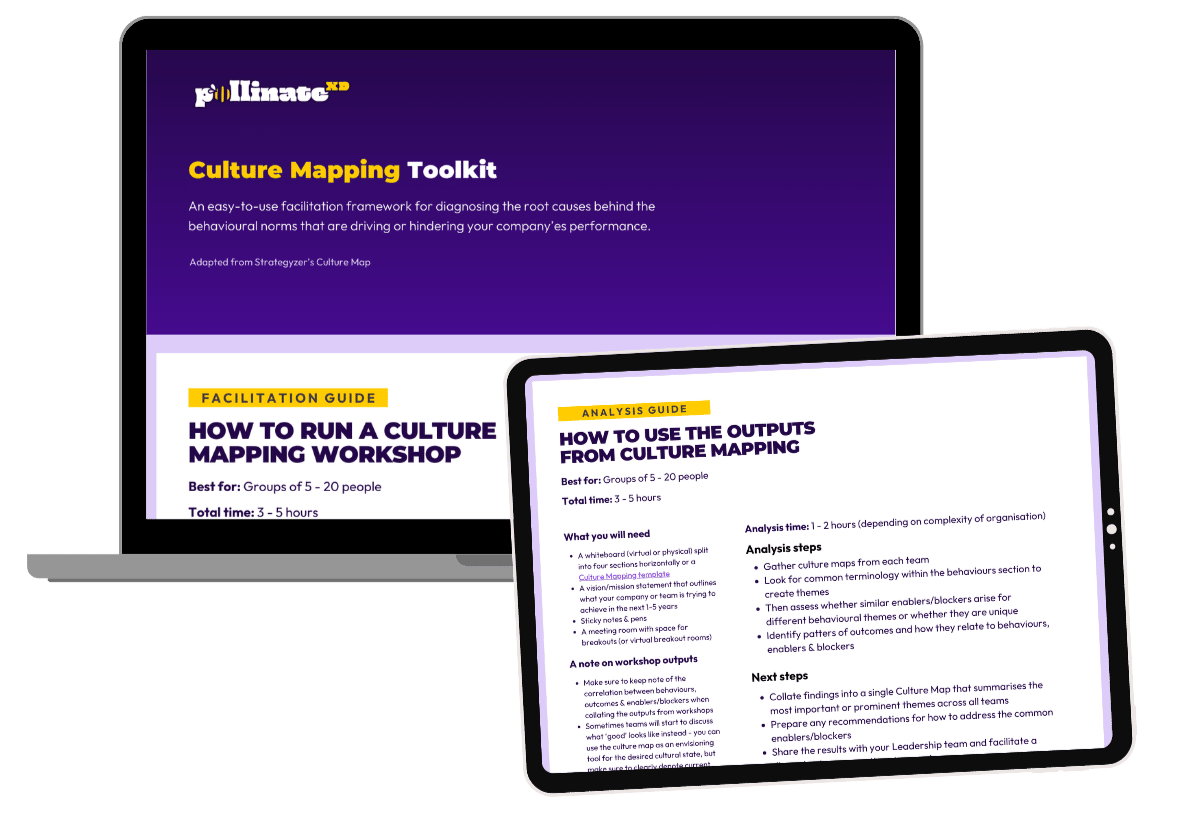
For step-by-step instructions on how to facilitate a Culture Mapping workshop and analyse the outputs check out this free Culture Mapping toolkit.
Turning insight into action
Culture mapping provides a practical view of how performance is really being shaped day to day, through leadership behaviour, decision-making norms, and the systems people work within.
Rather than starting with broad initiatives or abstract models, these insights help leaders see where performance is being enabled or constrained and why. This makes it easier to focus on the few changes that will have the greatest impact, rather than defaulting to generic programmes or organisation-wide fixes.
Used well, culture mapping supports better strategic decisions by:
- Prioritising the right solutions
Identifying the specific behaviours, policies, or ways of working that are limiting performance in particular parts of the organisation. - Guiding energy/time investment
Providing a clear line of sight between leadership behaviour, organisational systems, and performance outcomes, so investment is directed at the real problem or opportunity. - Designing a People Experience that supports performance
Translating insight into intentional choices about how work gets done, what leaders are accountable for, and the conditions teams need to perform at their best.
Why Culture Mapping works
One of the most persistent myths about culture is that it’s too soft or too complex to address directly. In practice, most organisations struggle because they haven’t taken the time to understand how leadership or HR policies and processes are motivating the everyday behaviours that shape organisational performance.
Investing a small amount of effort upfront to diagnose the current culture (by looking at behaviours, outcomes, and the drivers behind them) prevents months of unfocused activity later.
Culture Mapping provides a straightforward approach to align on what actually matters. It replaces guesswork with a shared view of the few changes that will make the biggest difference to performance.
If you’d like to try it yourself, you can follow PollinateXD's free Culture Mapping toolkit to run the exercise with your leadership team.
If you try Culture Mapping, let us know how you get on! Alternatively, let us know which People Experience & Performance challenge you're grappling most with to inform our next newsletter.
This newsletter was brought to you by Megan Trotter in collaboration with Crewmojo
👋 Hi, I'm Meg, a UXer turned PXer. I spent the early years of my career designing customer experiences and product strategy before hypothesising that the same principles could transform how we build workplaces. That led me to study Organisational Psychology and transition into People Experience (PX). I have a range of experience leading organisational transformation through human-centred design in small, scaling startups to large complex organisations like the BBC.
I started PollinateXD to help organisations build high performing leadership teams capable of creating the conditions for colleagues to do the best work of their lives.
If you'd like support with facilitating or leveraging the outputs of Culture Mapping, get in touch. In two weeks time, you'll be hearing from Mark again.
See you next month,
🐝 Meg
Director & People Experience Specialist @ PollinateXD
Want to talk through what this looks like for your organisation?
Book a demo