
Getting 75+% of your people satisfied with their career progression
Megan Bernard-May
In my last newsletter, I shared how qualitative conversations, paired with quantitative data, helped our people team prioritise our roadmap.
Our engagement revealed that more than 40% of our people were dissatisfied with their career progression, but it didn’t tell us why.
By following up with qualitative research, I learned that people felt they weren’t progressing because they weren't receiving constructive feedback throughout the year and were only told they hadn't done enough to progress during the salary review.
Imagine being told you're doing well all year, only to learn during a salary conversation that it wasn't enough.
It’s happened to the best of us…
But identifying a problem to solve is only half the job. The other half is designing something better.
One of my favourite design tools is Experience Mapping; it can act as both a backwards-facing tool to discover the current lived experience and a forward-facing tool to design the to-be experience.
By taking some time to map the current lived experience and then involving team members in envisioning what a great experience would look like, we ensure we design a solution that not only lands well but also makes a difference.
Using Experience Mapping to design better experiences
The value of Experience Mapping is that it goes beyond designing a process by shaping what the experience should look and feel like from our people’s perspective, and helps us identify which back-end processes, tools, training and employee comms will bring it to life.
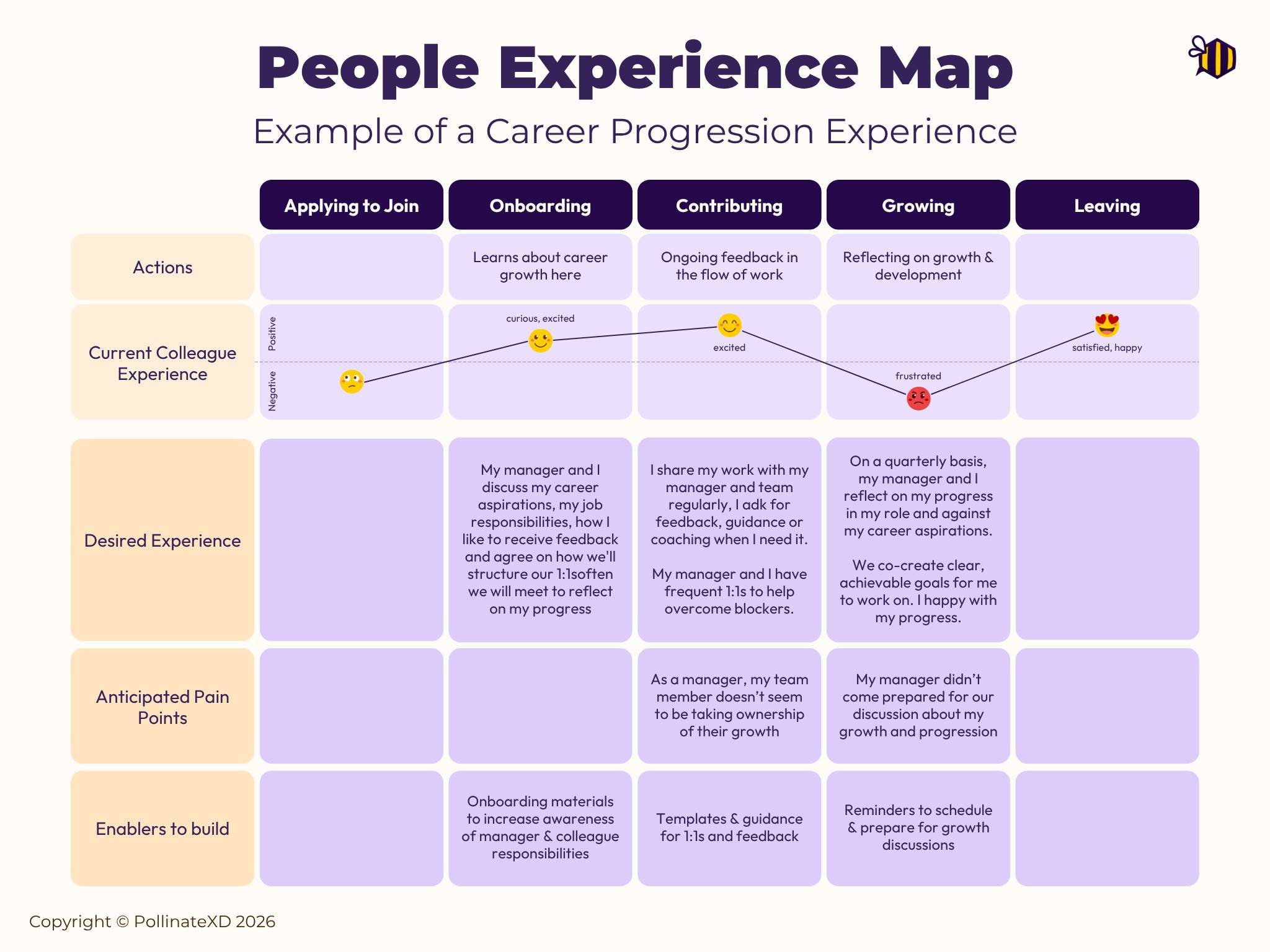
Here are the four steps to take to use Experience Mapping to design your next HR initiative:
- Identify the moments you're designing for. Don't just pick the main moment. Think about which other parts of the employee lifecycle should be building towards it.
- Envision the desired experience. Write it from the employee's perspective. What should it look and feel like? How do you want them to feel?
- Anticipate what could get in the way. Think about potential pain points from both the employee and the manager's perspective. What could prevent this from working?
- Design the enablers. What back-end processes, guidance, training, or communications need to be in place to bring the desired experience to life?
Step 1: Identify the moments you're designing for
Designing great employee experiences is a bit like a good stand-up comedy set. The best comedians don't just deliver one punchline. They lay out several smaller jokes that build towards a big one.
The same principle applies here. Rather than designing the progression moment in isolation, I asked: What other parts of the employee lifecycle should be building towards this moment?
For my project on improving the experience of recognition and feedback, I identified three moments that mattered:
- Onboarding: the first opportunity for a new joiner and their manager to align on expectations about their role, their career aspirations, how to give and receive feedback, and how frequently to discuss progression
- Contributing: the day-to-day working experience, where ongoing development conversations and feedback should be happening, so there are no surprises later on
- Career Conversations: where a team member and their manager reflect on their progress in their role and against their career goals, and refine their career development plans.
By mapping these as a connected journey rather than as separate moments, we could design an experience that builds momentum over time.
Step 2: Envision the desired experience
The next step is to gather descriptions from employees AND managers about what they would like each moment to look and feel like. The subtle but important distinction is that the experience is described from an employee perspective, not as an HR process:
- A process says "managers will hold quarterly reviews"
- A desired experience says, "on a quarterly basis, my manager and I reflect on my progress, but because I received feedback weekly, there are no surprises about how I’m going."
Even if you’re designing for an inherently difficult experience, the goal of experience design is to be intentional about how you want people to feel. This means describing how the less-than-ideal moments should feel to minimise any negative impact, or showing how the person could gain the most from an otherwise unwanted experience.
Step 3: Anticipate what could get in the way
Before building anything, it's worth spending time thinking about what could prevent the desired experience from happening. These are your anticipated future pain points; if you can anticipate them, you can design for them.
For the career progression experience, I identified potential pain points from both perspectives:
From the employee's perspective: "My manager didn't seem prepared for the conversation." If a manager shows up to a progression discussion without having reviewed progress or thought about growth areas, the whole thing falls flat. The experience becomes a tick-box exercise instead of a meaningful conversation.
From the manager's perspective: "My team member isn't taking ownership over their own development." If the employee expects their manager to drive their career for them, the conversation becomes one-sided, and neither party gets much out of it.
By surfacing potential blockers to the experience you’re designing early, you can build enablers to address them before they become problems.
Step 4: Design the enablers
Finally, consider what needs to be in place and when to bring the desired experience to life to reduce the likelihood of those pain points. I find it helpful to think about enablers in four categories:
⚙️ Back-end People Ops processes: the behind-the-scenes triggers and automations that keep things on track, like reminders to schedule and prepare for quarterly progression discussions.
📖 Guidance and templates: resources that help both parties prepare, such as 1:1 or retrospective templates.
💡 Education and training: for example, on how to give helpful, constructive feedback and express appreciation, or how to have effective career-coaching conversations.
📣 Announcements and comms: making sure people know what's available and what's expected. This is where many well-designed experiences fail: the solution is right, but nobody knows about it or understands how it works.
This is where Crewmojo is particularly valuable. Crewmojo can serve as the backbone for several of these enablers and ensure the experience you design actually happens.
Two things to take away
1️⃣ Design for an end-to-end experience, not just a moment in time
The career progression experience isn't just about the progression conversation. It starts on day one and is shaped by every feedback conversation, every 1:1, and every goal-setting session along the way. Experience mapping helps you see that full picture and design accordingly.
Start with one question: What should this experience look and feel like from my employee's perspective?
Then work backwards from there.
2️⃣ Don't design in isolation.
In HR, it’s easy to think we know best based on what’s worked before. But every organisation is different, with a unique mix of employees and managers, as well as distinct business goals and contexts.
When you’re designing for a particular experience, spending as little as 15 minutes with 5 people from across your organisation can help you to ensure your solution is bespoke to your organisation.
Want to talk through what this looks like for your organisation?
Book a demo