

Hey there 👋,
When HR initiatives get described with a label like performance management... I struggle to create a picture in my mind because it can mean so many different things.
But the label makes it sound like it's an actual "thing". Like it’s all been worked out for how the initiative "should" be achieved and this is normally coupled with industry best-practices that make for a compelling roadmap to follow.
You don’t realise just how much you can suffer (and the size of the wedge that can be driven between you and the rest of the business) by following this path.
My goal today is to equip you with a foundationally different approach that will set you up for success when tackling your next performance management refresh.
Before I move ahead, I do believe these top-level labels serve a purpose. They make a good anchor to frame the conversation and create context, but they don’t "define" what’s inside that frame.
To buy into this, you must agree first, that performance management in one company (when done well) is going to be different to how it looks in another company.
“Product market fit”
Just as a business needs to find its product market fit with customers, you need to find your performance management “product market fit” with employees.
Everyone knows what it feels like when you haven’t found it:
- Employees just go through the motions
- The process is "separate" to real work
- Managers complain about time and friction
- Actual outcomes are hard to define
So it begs the question, if we have industry best-practices... Why is it so hard to create a performance management product employees want to engage with?
Perhaps we should ask instead, have we ever heard employees ever saying:
- Awesome! I can’t wait to do performance management today!!
- Oooh, I just love building a culture of feedback.
- Yes!! It’s goal-setting season!
The reality is employees don’t want this product, they don’t care that you think it will help them. These initiatives are often seen as extra work in an already busy day. This is using what we call a 'push' approach:
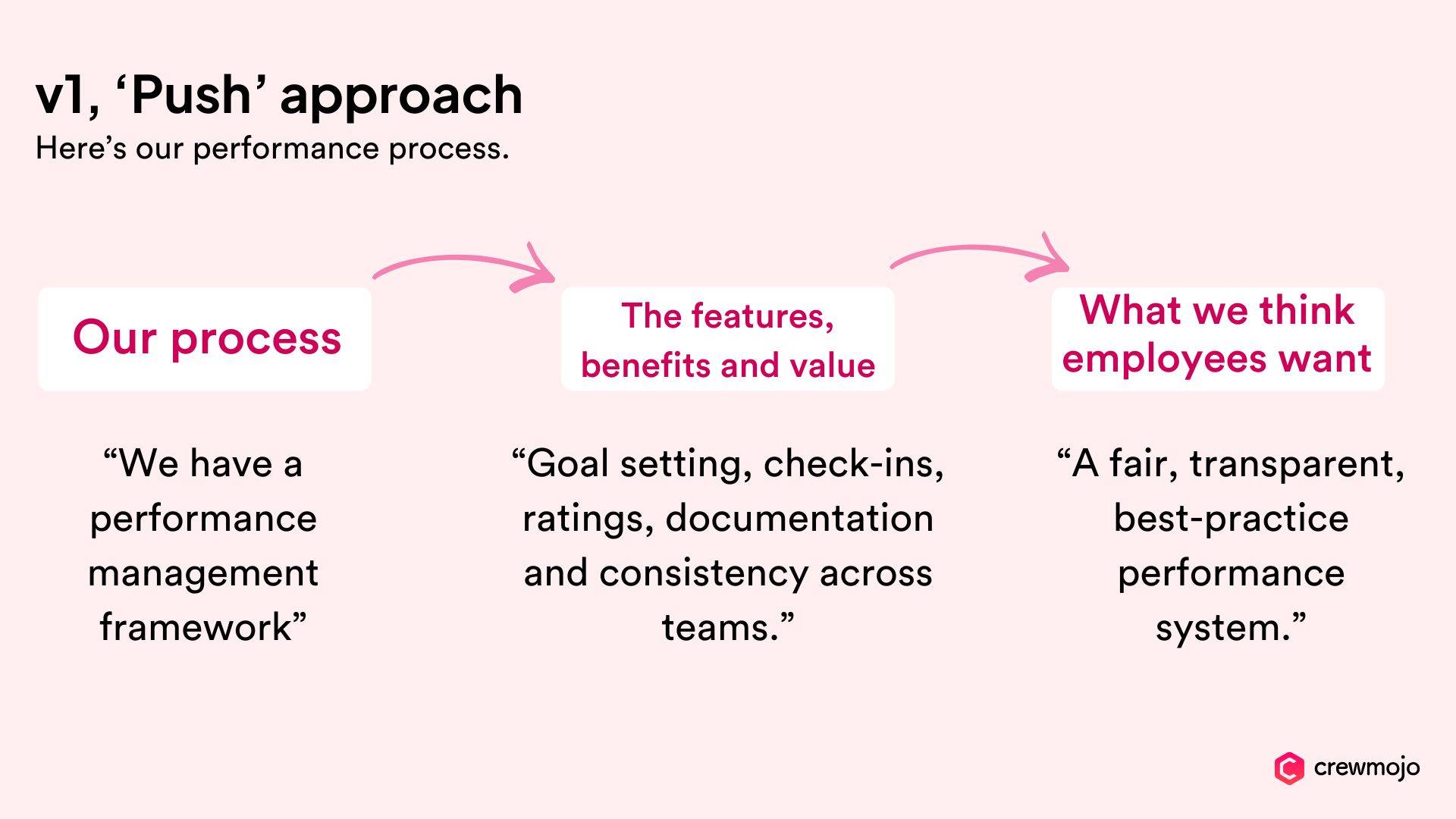
What might first-principles thinking look like for performance management.
The only dependable way I have found to think about performance management product market fit is bottom up, from a first principles perspective, aka from an employee perspective.
Similar to how a company wants to create "demand" with customers, you want to create "pull" with employees.
Pull nuances
- You can’t mandate belief in a performance product. People either lean into it or work around it.
- Pull exists silently - teams already have ways they try to get clarity, feedback, and performance assessment… with or without HR.
- Pull is about action - voluntary behaviours, or teams reusing tools without being chased.
- Pull is not your framework, language, or forms. Pull is relevance, friction reduction, helpful!
- Pull feels like employees pulling the system into their work, not HR pushing it in.
- And you can’t tell if pull exists by looking at the process. Two identical performance products can be received very differently depending on context.
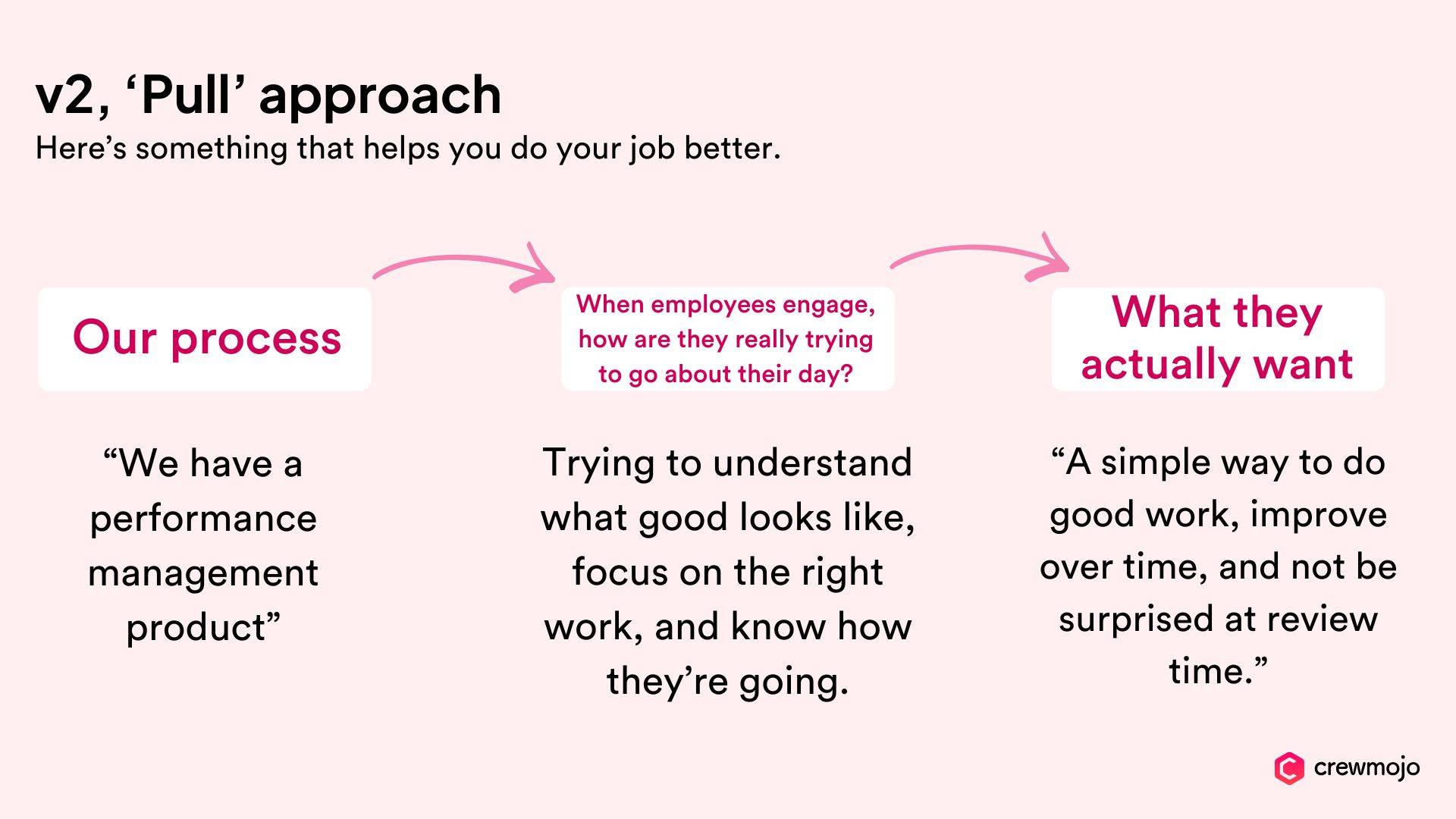
Once you accept that pull is what matters, the question changes.
It’s no longer “What performance process should we roll out?”
It becomes “What actually drives performance, from an employee’s point of view?”
When you strip performance back to first principles, it turns out there are only two levers that really matter.
Two ‘bottom-up’ performance levers
When employees are trying to do good work, they are usually navigating two things at the same time:
- Do I have the skills I need to do this well?
- Is the environment helping or hindering me?
Those two questions are applicable in every role, every team, and every organisation. They’re also the only two questions a performance system really needs to answer.
When you translate them from an employee’s perspective into something you can design for, they become two very practical, relevant and helpful performance levers.
- EMPLOYEE CAPABILITY:
What capabilities do employees need - to accomplish the things they need to do at a high standard?
- SUCCESS CONDITIONS:
What conditions need to be in place to maximise employee’s chances of success?
Both levers matter. But it's easy to get overly focused on "improving" employees (by lifting their capability). Many employees are receptive to self-improvement but others just want to do their job.
Modifying the conditions around an employee can significantly improve (or reduce) performance across the entire workforce without any change to individual capability.
Performance problems are often environment problems
When performance drops, our instinct is to look at the person.
They need more capability.
More training.
More coaching.
More motivation.
But if you step back and look through a first-principles lens, many performance issues have very little to do with effort or skill.
They’re signals that the environment is working against the person.
A few common examples:
- Priorities change faster than goals are updated
- Expectations are implied or not properly communicated
- Feedback happens too late to be useful
- Dependencies sit outside the employee’s control
- Tools or processes add friction instead of removing it
In these situations, asking someone to "perform better" is unrealistic. They’re already doing the best they can within the conditions they’ve been given.
So what can you actually do about conditions?
The good news is you don’t need to redesign everything to have an impact.
Spend time understanding where friction shows up in day-to-day work. Not at review time. Not in surveys. In the actual moments where people are trying to do their job.
That might mean sitting in on team meetings, listening to how managers talk about priorities and using this discovery to find when work slows down or where people get frustrated.
From there, the work becomes surprisingly practical.
You can help managers to articulate and get clearer on what "good" looks like in their team
You can raise the topic of competing priorities in management meetings and facilitate discussion on how to resolve that tension.
You can identify the behaviours that don't match company values.
You can simplify or remove steps that don't match the way people really work.
None of this requires a big rollout.
In fact, the most effective changes to conditions often feel small. Almost boring. But they’re immediately felt by employees because they reduce friction in their everyday work.
This is also where your role subtly changes to become a designer of the environment where performance naturally happens. You become less focused on enforcement, and more about orchestrating the right environment.
When conditions improve for managers and employees, something interesting happens.
You don’t need to chase engagement or convince people that performance management matters. Pull starts to emerge on its own.
Bringing it all together
Performance management struggles if you treat it as a fixed system that needs to be rolled out, and employees need to comply with.
It works better when it’s treated as something that is built, tested, and adjusted in your context.
If there’s one idea worth holding onto, it’s this:
Before trying to change people, look at the conditions they’re operating in.
Ask them what’s helping.
Ask them what’s getting in their way.
Then you're on the same side of the table where employees don't feel like you are simply seeking to extract more from them.
They become involved in designing the environment that allows them to bring their best performance.
Mark
CEO @ Crewmojo